We build systems for local businesses.
We start with the problem, not the product. We learn how your crew actually works, find what keeps breaking, and build the software that fixes it. About two weeks to build, then we keep it running for you.
| RO | Vehicle | Stage | Tech | Due |
|---|---|---|---|---|
| 4821 | 2019 Tacoma | Waiting on parts | Body 2 | Thu |
| 4825 | 2022 RAV4 | In paint | Paint 1 | Wed |
| 4830 | 2017 F-150 | Ready for pickup | Detail | Today |
| 4833 | 2020 Civic | Estimate | Front desk | Mon |
You run a real operation. Your software was built for an office.
So the crew works around it: a whiteboard, a group text, one person's memory. Find your floor below. If two or three of these are your Tuesday, we should talk.
Collision and auto body
Dental labs
Cold storage and 3PL
Farms and nurseries
Food producers
Towing
Sign shops
Something else?
If your crew does the same physical work every day and the software doesn't match, that's my lane.
Tell me about it →These are the exact problems I solve. I've already solved them on my own floor.
Custom software used to cost too much for a business your size. AI changed that. I use it to build you the system your crew actually needs, and I make sure it's right.
I ran the floor before I built for it.
As Head of Operations at West Coast Deals, a live-commerce company with warehouses in Portland and Los Angeles, I built every system the crew runs on. One year in, with the same tools:
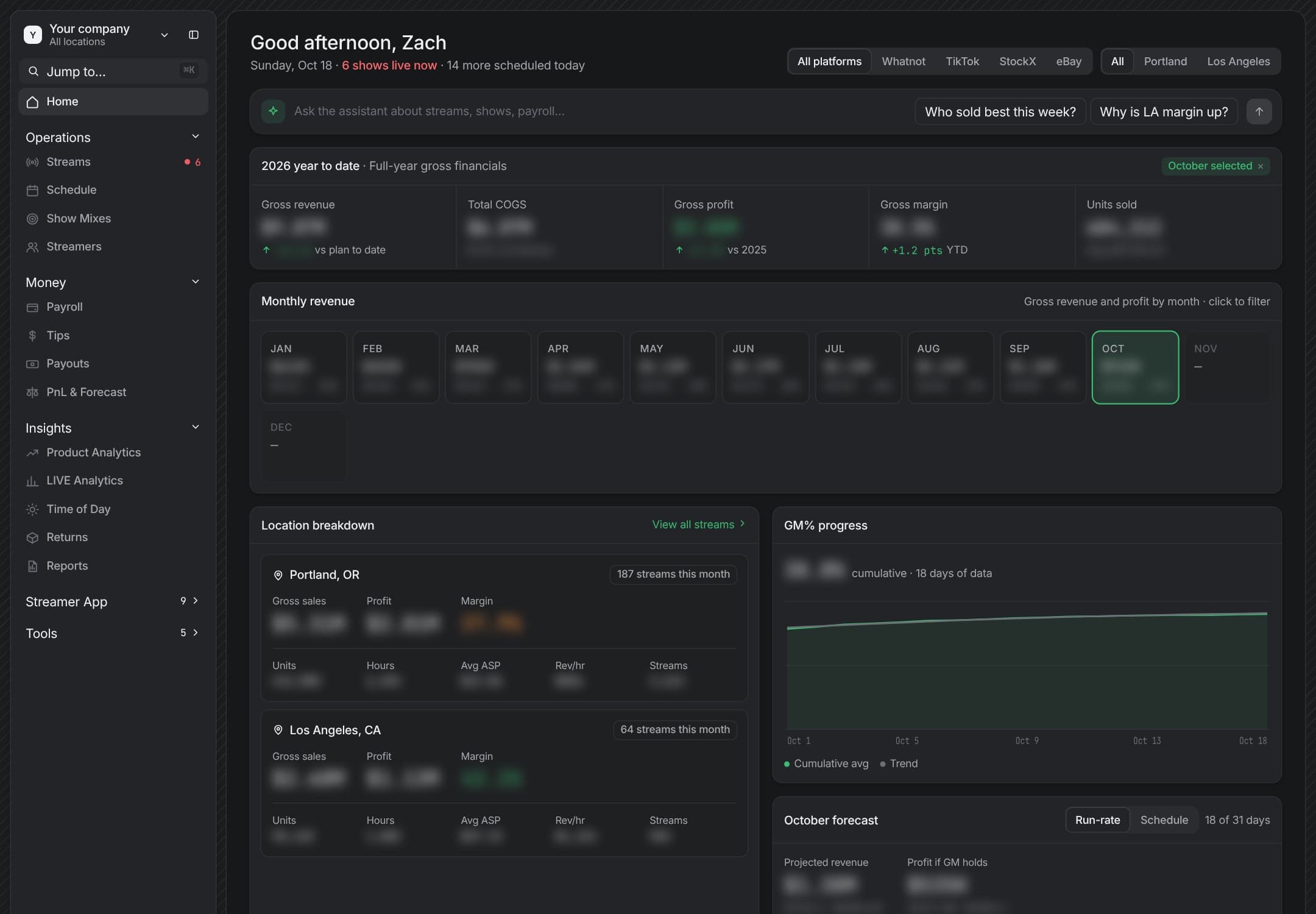
Growth figures compare the first full month on the new systems (Oct 2025) with the latest full month (Sep 2026).
Call, floor walk, working system. About two weeks.
We talk
You tell me what keeps breaking. I tell you honestly if I can fix it.
I walk your floor
I watch the work, talk to the crew, and write a one-page spec you approve.
I build
The system your crew needs, built to the spec you signed. You see it come together along the way.
I train your whole team
I onboard and enable everyone who touches it, no matter the size of the crew, and fix what breaks in week one.
You decide
Keep it on a monthly plan, or cancel and owe nothing. The first tool is free either way.
Show me what keeps breaking. I'll fix it.
30 minutes. No pitch. If it's a fit, I come walk your floor and build your first tool for free.

Rather email? Zach@ZTLSolutions.com
Why FloorStack?
Do I need to understand AI?
No. That's my job. You know your floor. I know how to turn what you tell me into software your crew will actually use.
What's the catch with the free tool?
There isn't one. I'd rather prove it on your floor than pitch you. We sign simple terms up front: it converts to a monthly plan at day 30 unless you cancel.
Do I have to replace the software I already use?
No. What I build can sit beside it and fill the gaps it leaves on the floor.
Who owns the code and the data?
You do. If you ever leave, you take both with you.
What does it cost after the first tool?
The first tool is free. If you keep it, it moves to a flat monthly plan we agree on before day 30. Anything else you want built is scoped and priced before I start. No hourly billing, no surprises.
Where do you work?
Portland and the surrounding metro, in person. The floor walk has to happen on your floor.